
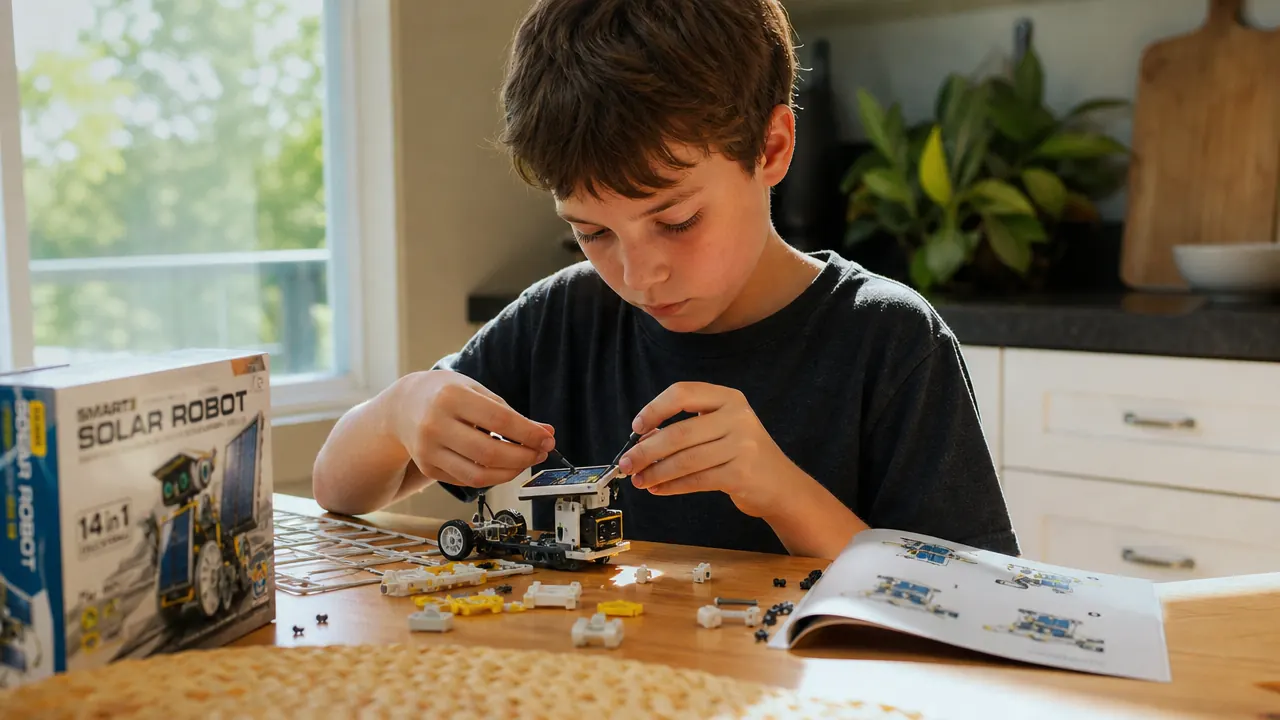
I have been teaching third grade for eleven years and homeschooling my own two kids for three. I thought I had science covered. I had the spine curriculum, I had library books, I had YouTube videos queued up for every unit. What I did not have was a nine-year-old who actually wanted to sit down and do it. My son Caleb treated science the way most kids treat the dentist. He'd show up, do the minimum, and disappear.
I bought the Sillbird 12-in-1 Solar Robot Building Kit on a Tuesday afternoon mostly out of desperation. It was budget-friendly, had over fifteen thousand reviews, and the box promised he could build twelve different configurations powered entirely by the sun. I figured worst case it was a fun afternoon project. I did not expect it to become the thing that finally made science click for him.
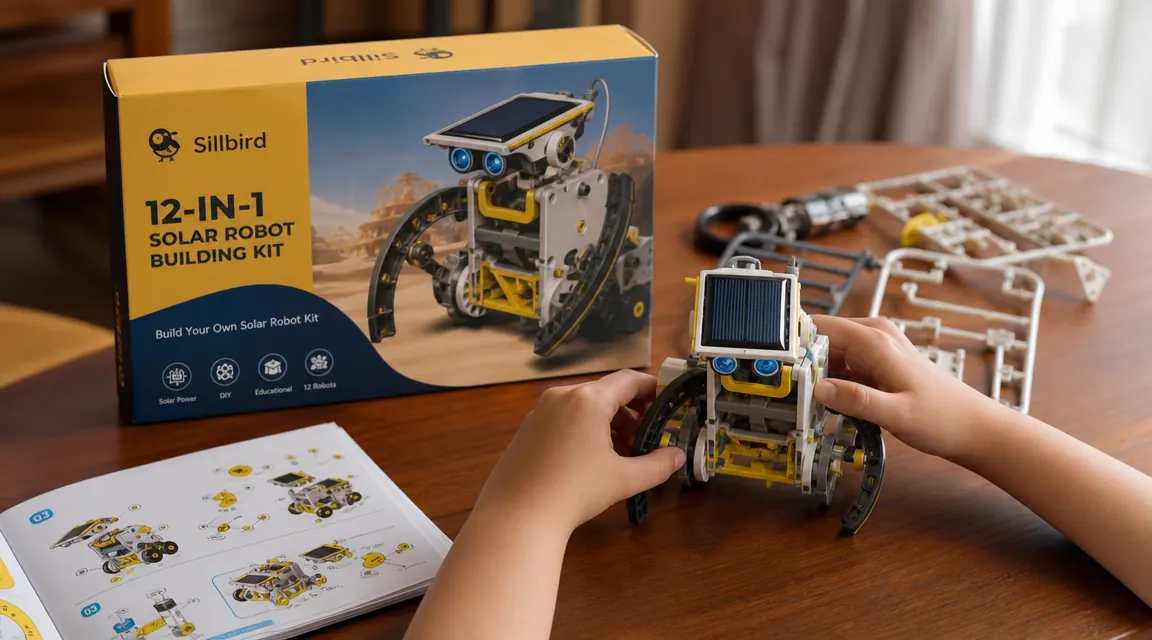
The box arrived Thursday. By Friday morning, Caleb had already read the instruction booklet cover to cover without anyone asking him to. That had never happened. Not once in three years of homeschooling. He sat at the kitchen table for an hour and a half building the first robot, a six-legged crawler, asking me questions the whole time: how does the solar panel turn light into electricity, what is a gear ratio, why does the robot go faster when you point the panel directly at the light. I answered what I could. For the rest, we looked it up together.
The kit has 190 pieces and builds twelve different robot forms. The instructions are clear enough that a careful eight-year-old can follow them independently, though Caleb still liked having me nearby to talk through the concepts. What I noticed right away is that the building itself IS the science lesson. He is not reading about gears and solar energy and motor circuits. He is holding them, connecting them, figuring out why something does not work and fixing it. That process, the troubleshoot-and-try loop, is what classroom worksheets almost never deliver.
He sat at the kitchen table for an hour and a half, asking questions the whole time. That had never happened. Not once in three years of homeschooling.

By the end of the first week, Caleb had built four configurations and started a science notebook where he sketched each robot and wrote down what he learned. That notebook was his idea, not mine. He wanted to remember which builds used the most gears and which configuration went fastest in afternoon sunlight versus morning sunlight. On his own, he had designed a little experiment. I nearly cried. This is exactly the kind of intrinsic motivation I spent a decade trying to manufacture in my classroom with elaborate lesson plans, and here it was showing up organically because a twenty-dollar toy gave him a problem worth solving.
If your kid treats science like a chore, this kit might be the thing that changes that.
The Sillbird 12-in-1 Solar Robot Kit has 4.3 stars and more than 15,000 reviews on Amazon. It is inexpensive, requires no batteries, and builds twelve different configurations. We used it to cover solar energy, simple machines, and basic circuitry in our homeschool.
Amazon Check Today's Price on Amazon →There are a few things I would tell any parent before they hand this kit to a child. First, the pieces are small. The kit says ages eight and up and I would hold to that. Younger kids will need significant adult help, and some of the connectors require real finger strength to snap together. My seven-year-old daughter Maya watched a lot of the builds but did not do much solo assembly. That was fine. She still absorbed the concepts by watching her brother work through the problems.
Second, the solar panel works best in direct sunlight or under a strong indoor light. On overcast days or in a darker room, the motors may stall. We used a simple desk lamp on gray-sky mornings and it worked well enough. Caleb actually turned this into another experiment, testing different light sources and distances to see what produced the most robot movement. Again, not my idea.

Third, do not try to rush through all twelve builds in one sitting. Space them out. Each configuration is a chance to revisit the same concepts from a new angle. We did about two builds per week over six weeks, and that pacing gave us time to really discuss what changed between configurations and why. That is where the deeper learning happened, in the conversation afterward, not just the building.
If you want to see a full breakdown of what this kit covers and how it compares to other STEM building kits, I wrote a longer review over at the Sillbird Solar Robot Kit review. And if you are wondering whether STEM kits in general are worth the investment, I also put together a piece on the 10 reasons STEM building kits help kids learn faster that lays out the research behind why hands-on building works the way it does.
What I'd Tell You If We Were Sitting at My Kitchen Table
Here is what I would say to you if we were sitting at my kitchen table with coffee, the way I talk to the other homeschool parents in my neighborhood. Do not overthink this. If your kid is anywhere from eight to thirteen and has any spark of curiosity about how things work, this kit will feed it. It is not perfect. The pieces can frustrate younger builders, some configurations are fiddlier than others, and it will not replace a full science curriculum on its own. But it does something that most science tools do not: it makes a child feel like an engineer. It gives them a real problem, real pieces, and a result that either works or does not, with no ambiguity. That kind of concrete feedback loop is genuinely rare and genuinely valuable. I have seen what it did for Caleb. At a budget-friendly price, it is one of the most effective things I have put in our homeschool this year.
Ready to see what it does for your kid?
The Sillbird 12-in-1 Solar Robot Building Kit ships with 190 pieces, 12 build configurations, and instructions clear enough for ages 8 and up to follow independently. No batteries. No screens. Just a solar panel and a whole lot of questions.
Amazon Check Today's Price on Amazon →