
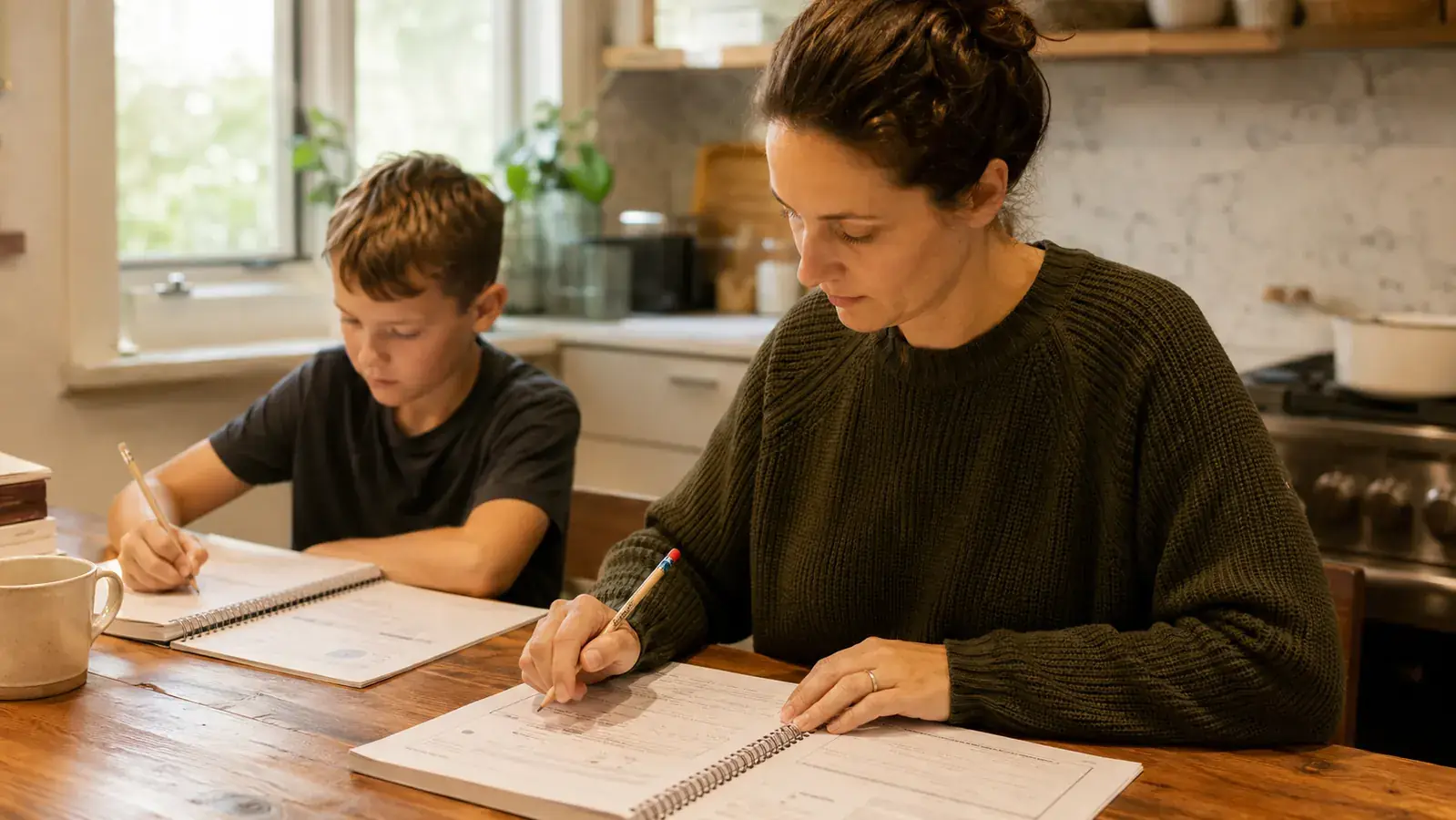
I taught 4th grade for nine years in a public school system where curriculum alignment actually mattered. We tracked standards, we paced deliberately, and we knew which supplemental materials actually held up to scrutiny and which ones just looked good on a shelf. So when I pulled my daughter Lily out of her 5th-grade classroom two years ago to homeschool her, I did not just grab whatever workbook had good reviews on Amazon. I treated it the way I would have evaluated a classroom resource, which means I read it before I bought it, cross-checked the skill progression against Common Core standards, and planned to use it critically rather than passively. What I found about the Carson Dellosa Comprehensive Curriculum of Basic Skills, Grade 5 is probably not what the listing promises you. Some of it is genuinely good. Some of it will frustrate you if you have a teacher's eye. All of it is worth knowing before you spend your money.
The Quick Verdict
A solid, affordable foundation for homeschool review work, but the depth on writing and science topics is thinner than the page count suggests. Best used alongside a dedicated grammar resource, not as a standalone.
Amazon Check Today's Price →If your 5th grader needs structured daily practice across every core subject, this workbook delivers that at a price that makes it easy to say yes.
At its current price, the Carson Dellosa Comprehensive Curriculum Grade 5 is one of the lowest-cost ways to get a full year of cross-subject practice pages in a single bound volume. Check current pricing on Amazon before deciding.
Amazon Check Today's Price on Amazon →How I Actually Used This Workbook
I did not use this as our only curriculum resource, and I want to be upfront about that. In my years of teaching, I never met a single classroom workbook that could stand entirely alone, and this one is no exception. What I did was use it as our daily warm-up driver. Lily and I sat at the kitchen table each morning, I poured coffee, she had her water bottle, and we worked through two to four pages before moving to anything else. That structure alone made a real difference in her consistency. The workbook gave us a touchpoint, a shared object to open together, which turned out to matter more than I expected.
Over about eight months, we completed roughly two-thirds of the book. We skipped sections where I knew her mastery was solid from prior-year work and slowed down significantly in the fractions and geometry chapters, because the problems in those sections actually did escalate in difficulty at a pace I respected. I marked pages with sticky tabs, flagged problems I found poorly worded, and noted where a concept was introduced without enough scaffolding. This is my honest log from that process.
What Nobody Tells You About the Math Sections
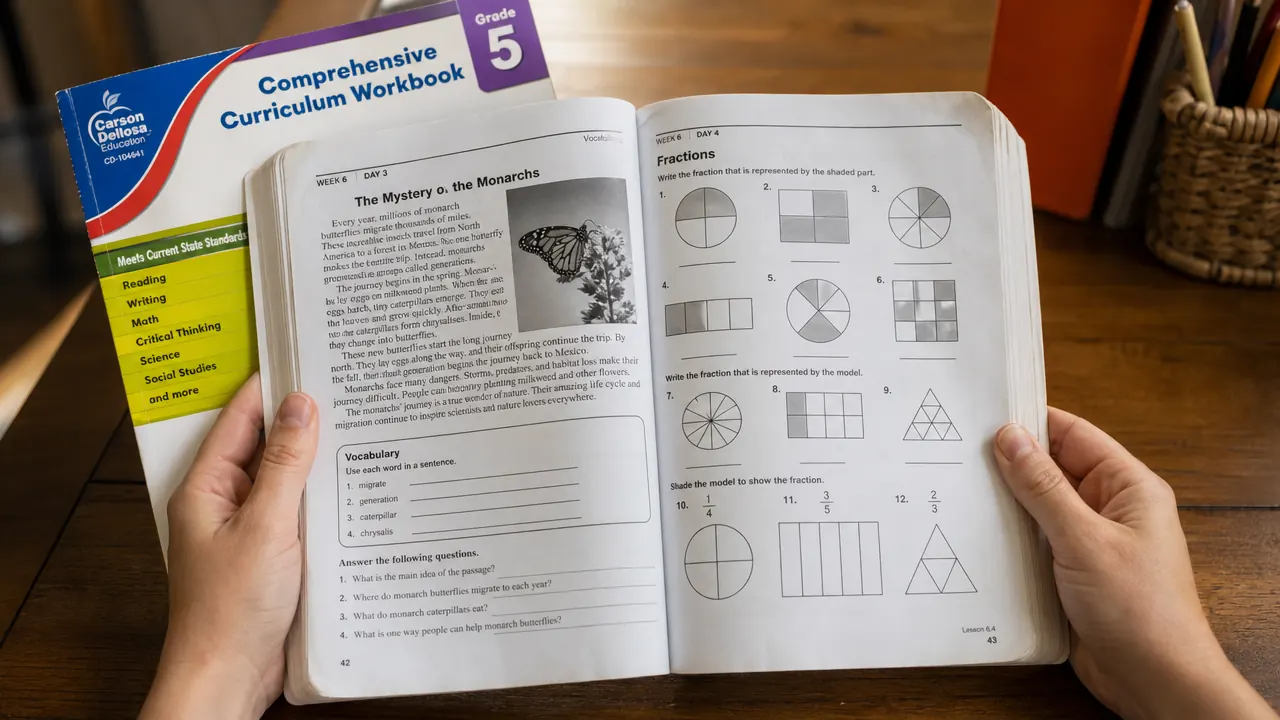
The math coverage is the strongest part of this book, and I say that with some real surprise. Fractions, decimals, geometry, and basic algebra readiness are all present, and the difficulty progression within each math chapter is genuinely logical. Problems start with direct computation and move toward multi-step word problems with enough variety that a student cannot memorize a pattern to get through them. Lily, who is strong in computation but resistant to word problems, could not skip the thinking steps. That is a design win.
What nobody mentions in reviews is that the answer key is in the back of the student book. That sounds fine until your 10-year-old figures it out on day three. I ended up pulling the last 20 pages of the book out entirely and storing them separately. It is a minor logistical issue, but if you are buying this for independent learner practice while you handle another child, know in advance that you will want to remove or obscure those pages. A spiral-bound version with a separate answer booklet would solve this, and I hope Carson Dellosa addresses it in a future edition.
The geometry chapter introduced vocabulary that, by my read, sits closer to 6th-grade level than 5th. Concepts like classifying triangles by angle and side measurement appeared earlier in the skill sequence than I expected. For an advanced student this is a bonus. For a student who is already finding the transition to 5th-grade math tough, it may land as discouraging rather than challenging. Plan to preview those pages before assigning them on your own.
The Reading Comprehension Pages Are Good, But Grammar Falls Short
Reading comprehension is well-handled throughout. The passages are grade-appropriate in length, they represent multiple genres including informational text and fiction, and the follow-up questions require genuine inference rather than just locating an answer in the text. Lily actually liked these sections more than I expected, which I credit to the passage topics being genuinely interesting. One passage about cave formations, another about the history of roller coasters. Not the generic filler text I feared.
The reading passages are genuinely interesting for fifth graders. But the grammar section feels like it was written for a different book entirely, like someone filled the remaining pages at the end of a deadline.
The grammar sections, however, are where my teacher eye started flagging things. The activities often ask students to identify parts of speech in isolated sentences rather than in context. That mirrors an older instructional model that most current literacy research has moved away from. Students can identify a noun in a sentence strip and still write incoherently in paragraphs. The grammar exercises in this workbook will not close that gap. If grammar is a weak area for your student, I would strongly recommend pairing this book with a dedicated grammar workbook or a program like Daily Grammar Practice rather than assuming these sections will build writing strength.
The writing prompts included across the book are minimal and surface-level. Most are single-sentence instructions like "Write a paragraph about your favorite season." There is no writing process scaffolding, no graphic organizer, no example. For a student who already writes confidently, that is fine as a quick exercise. For a student still learning to organize ideas on paper, it will produce frustration without growth. This is my single biggest gap complaint with the book.
Science and Social Studies: Present but Thin
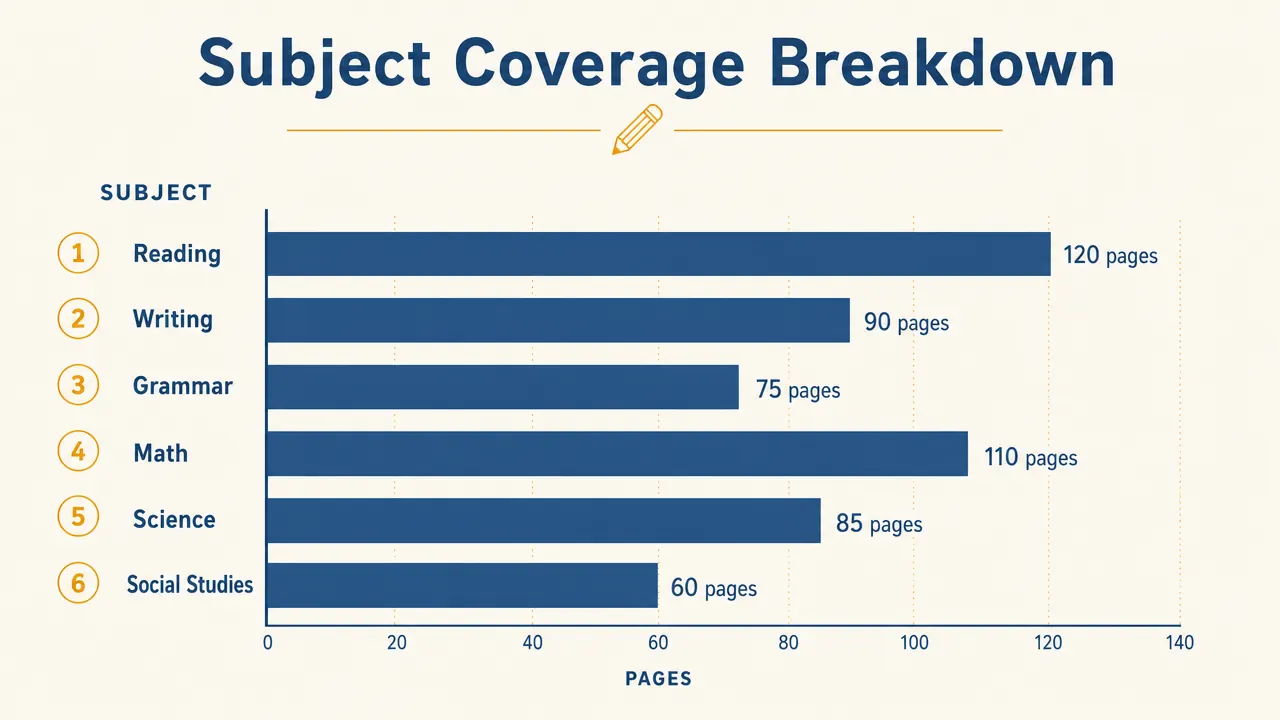
The science and social studies pages exist, and I appreciate their presence in a workbook that bills itself as comprehensive. But I want to be honest about what they are. They are reading-based review pages, not hands-on or inquiry-driven content. You will see a paragraph about photosynthesis followed by fill-in-the-blank questions. That is fine for vocabulary reinforcement and basic fact checking, but it is not science instruction. If you are building a full homeschool science program, this workbook contributes about 10 to 15 minutes of reading-based reinforcement per week at the pace we used. Useful. Not sufficient on its own.
The social studies sections lean heavily on geography and early American history, which aligns with typical 5th-grade social studies scope in most states. The maps included are clear and the activities are functional. I used some of these pages as supplemental material even outside our regular workbook routine when Lily needed a quick review before a co-op session. They held up fine for that purpose.
What I Liked
- Math sections are genuinely rigorous with smart difficulty progression
- Reading comprehension passages are high-quality and engaging for 5th graders
- All core subjects in one bound volume keeps mornings simple
- Budget-friendly, which makes it accessible for families on tight education budgets
- Nearly 500 pages provides enough material for a full school year at a light daily pace
Where It Falls Short
- Answer key is in the back of the student book, not in a separate booklet
- Grammar exercises rely on isolated sentence work rather than applied writing context
- Writing prompts have no scaffolding and will not help struggling writers improve
- Science and social studies sections are reading-based only, not inquiry or lab-based
- Some geometry content reads as 6th-grade level, which may discourage struggling students
Paper Quality and Physical Durability
The paper is thicker than I expected for a workbook at this price. Pencil does not ghost through to the back side, which matters more than you think once your child is actually doing daily pages. Lily uses a mechanical pencil with heavy pressure and we had zero bleed-through in eight months. The binding held through repeated daily use without pages loosening, which is more than I can say for some educational workbooks I have used in classroom settings that come apart after two months of normal handling.
The font sizes are generous enough that students with any sensitivity to small print will not be fatigued by the pages. Illustrations are black-and-white but clear and purposeful rather than decorative filler. The overall visual design is clean without being so plain that it feels sterile. These are small things, but they matter in practice when your child is sitting with this book for 20 to 30 minutes at a stretch.

How This Differs From What the Other Review Covers
If you read the full-year homeschool parent review on this site, you will get a picture of what sustained use looks like over an entire school year from a parent lens. That review covers pacing, routine, and what changed academically over time. What I am offering here is something different: a curriculum evaluation from someone who has read school standards documents, observed classroom instruction, and designed scope-and-sequence materials professionally. The differences matter. A parent can tell you whether their child finished the book. A former teacher can tell you whether what is in the book is accurate, appropriately leveled, and instructionally sound. Both are useful. This review is the latter.
My overall finding is that Carson Dellosa did solid work on math and reading comprehension, adequate work on science and social studies, and noticeably weaker work on the writing and grammar sections. That is not a dealbreaker, but it is information you need to plan around rather than discover mid-year. See the full side-by-side comparison against Spectrum workbooks if you want to weigh your options before buying.
Who This Is For
This workbook is a strong fit for homeschool families who want a reliable daily-warm-up tool or a structured review resource for a 5th grader who is on-grade-level or slightly ahead. It is also an excellent fit for parents supplementing a traditional school year over summer break, because the breadth of subjects in a single volume means you are not juggling five separate workbooks. If your child is a strong independent worker, the pages are clear enough to assign without much hand-holding. And at the current price, it is the most cost-effective way I have found to cover this many skills in one purchase.
Who Should Skip It
Skip this workbook if your 5th grader has significant writing gaps. The grammar and writing sections will not move the needle for a student who needs explicit, scaffolded writing instruction. You will get better outcomes from a dedicated program for that specific skill area. Also skip it if you are hoping to use it as a complete, standalone homeschool curriculum without layering in other resources. The science and social studies pages are too thin for that. And if answer-key proximity is going to be a management problem in your household, solve that before day one, or buy the digital version if available and print it yourself without the key.
If you need one workhorse workbook that covers math and reading for a 5th grader without breaking the budget, this is the one I keep recommending.
The Carson Dellosa Comprehensive Curriculum Grade 5 has real strengths in math and reading comprehension, and the price makes it hard to find a better value for daily practice. Just pair it with a separate grammar resource and you are set for the year.
Amazon Check Today's Price on Amazon →